The power brokers: Black leaders and landowners hold the bargaining chips in future MLK Corridor development

News Based on facts, either observed and verified directly by the reporter, or reported and verified from knowledgeable sources.

Pointe South Business Group former chair Hank Lawson, right, and interim chair Zach Thompson stand at the MLK Jr. DART Station on Aug. 14, 2025. Photo by Camilo Diaz Jr.
Most DART Rail riders avoid the Green Line’s Martin Luther King Jr. Station.
State Fair of Texas commuters detrain at Fair Park Station, from which pavement and dramatic uplighting make a walk to the iconic midway or Music Hall feel safe.
That’s not the case three quarters of a mile down the tracks, at MLK, whose platform gives way not to smooth sidewalks but dim, flood-prone streets — an area that community leader Hank Lawson describes as a “safe space for all the wrong things.”
“Drugs, prostitution, fencing of stolen goods, violence, killing, you name it.”
Soon after the station’s installation some 15 years ago, the City of Dallas crafted a plan to transform the surrounding Martin Luther King Jr. Corridor. That plan never made it off the shelf, says Lawson, a longtime resident of the nearby South Boulevard/Park Row neighborhood.
So three years ago, fed up with all the money and attention allotted to the MLK Corridor that hadn’t benefitted surrounding residents, Lawson formed the Pointe South Revitalization Committee, a group dedicated to turning things around.
Composed primarily of the corridor’s property owners, some homeowners but mostly commercial landowners, the committee considers this DART stop an insult, emblematic of how the City prioritizes Fair Park and other areas over their historically Black neighborhood.“Lighting or features that enhance safety or the capacity to walk off the Green Line went to Fair Park Station,” landowner Dennis Bryant said during a tour of the area, leaving them comparatively in the dark.
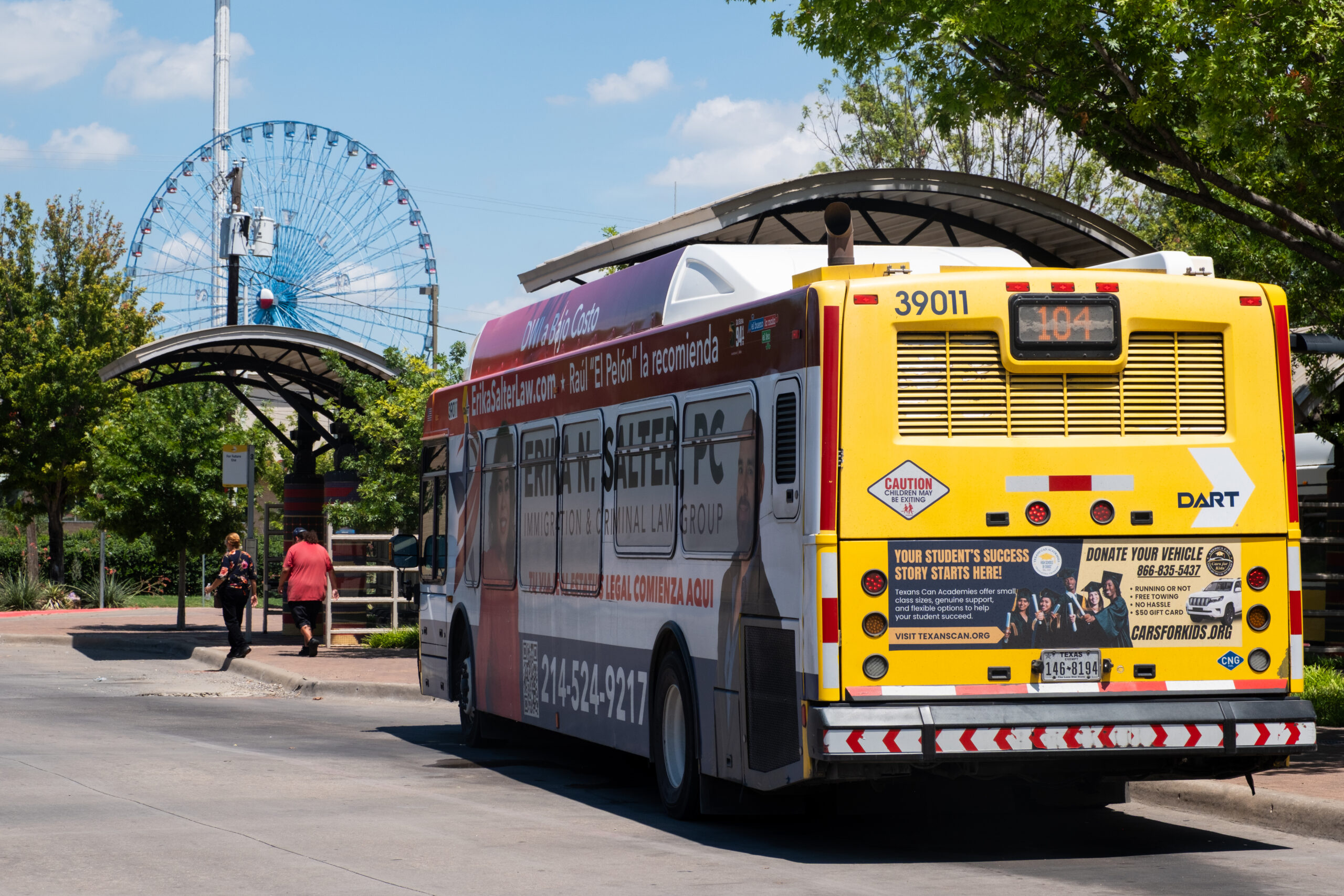
A DART bus drops off passengers at the J.B. Jackson Jr. Transit Center on Monday, Aug. 4, 2025. Photo by Camilo Diaz Jr.
An ‘infrastructure desert’ along JB Jackson
Bryant and Lawson were at the Fourth Avenue Church of Christ on Park Row that misty spring morning, demonstrating to Southern Methodist University students the meaning of “infrastructure desert.”
SMU has designated South Dallas one of 62 Dallas-Fort Worth infrastructure deserts, or zones lacking the foundation on which to build a “safe, functional and economically viable” space in which to live, according to researchers at the university.
Most of these generally low-income communities occupy the southern part of Dallas and are inhabited “primarily by Black and Hispanic residents,” according to university researchers.
Bryant owns acreage in the MLK Corridor, and says when he began assessing his land for potential sale, he immediately encountered a problem that illustrates the issue: The storm water drainage system stops where his property starts, rendering his land unsellable until a system is installed, at a cost of tens of millions.
For several decades, the absence of a drainage system has been causing street flooding. Neighborhood property owners told news reporters in January that they were suffering dangerous conditions and paying for nonexistent services.

A street corner that is prone to flooding, located next to the MLK Jr. DART station, pictured on Aug. 14, 2025. Photo by Camilo Diaz Jr.
City spokespersons responded to the discovery, telling WFAA that there have been no consistent complaints.
But the lack of adequate infrastructure is tied directly to the days of redlining, the SMU study says, when Black homeowners were relegated to certain neighborhoods.
Bryant and Lawson suggest that ignoring something like flooded streets is part of the collective and deeply ingrained generational acceptance among their neighbors that nothing will ever change.
Halting the tour group near the MLK station, Lawson asks if anyone can guess why homeless people flock to DART rail stations such as this one. After a couple incorrect guesses, such as “bathrooms” (there aren’t any) and “lighting” (there isn’t much), he tells us it’s because those experiencing homelessness can ride the climate-controlled trains all day. DART day passes are $6. Passengers without a ticket may receive a $50 citation, but there is no consequential enforcement, Lawson says.
“Then, they get off here, where no one is around to bother them,” Lawson adds, gesturing to a shopping cart containing a dingy pillow, some towels and empty prescription bottles.“Their safe haven.”

Passengers wait for the DART light rail train on Aug. 14, 2025, at the MLK Jr. DART station. Photo by Camilo Diaz Jr.
Thinking beyond small, reactionary change in the MLK Corridor
Lawson believes the neighborhood is well past the point of more police or code enforcement, which affect micro-changes at best.
He believes revitalization lies in new construction and transit-oriented development on the vacant land surrounding the station.
The idea is shared by potential developers as well as the area’s big landowners, who, while they want to make money, also care about the neighborhood, according to Cameron Deptula of Davidson-Bogel Real Estate. He represents landowners like Bryant in brokering real estate deals.
“Development is the greatest catalyst for growth,” Deptula says. “And if you don’t have it, it’s just the same old thing.”
Bryant, Rudy Perez and Devin Hall collectively own a majority of the lots inside the corridor, altogether some 27 acres that are identified on Davidson-Bogel’s website. They have formed a small contingent to streamline and push development progress, Deptula says.
“Many of our goals line up with Pointe South, the priority of concerns are similar, but how to go about addressing those concerns and then our ability to actually handle these complex situations sometimes differ greatly.”
It’s hard to believe, listening to the confusing, often overwrought dialogue surrounding MLK corridor plans, or looking at the tattered tents and discarded needles around MLK station, but behind the scenes progress is underway.
The collaborative attitude among these three MLK corridor landowners and their collective willingness to consider input from neighborhood stakeholders as they work with the City to prepare and sell the land is, in large part, attributable to Lawson’s years of dogged facilitation.
“Now we’re closer, not close enough, but closer than we have ever been before” to large-scale transformation, Lawson says with due caution, considering the high stakes and intense, complicated work ahead.
Fair Park landowning trio ready to deal
Real estate development can get complicated.
Those involved in the potential development around Fair Park, one of the country’s most visited tourist attractions, have entered a logistical and bureaucratic labyrinth through which they might move, progress and regress for months and years. There is no guarantee they will make it out or gain anything for their effort.
For landowners ready to sell and pro-“appropriate development” neighbors like Lawson, a desired outcome depends upon dealing with the City of Dallas, its staff and elected officials, something property owners in Fair Park/South Dallas have long avoided, Lawson explains.
“No one here calls the police. The police never cared. These landowners along the Green Line gave up on the police and accepted the abandonment of City services to their community 30 years ago.”
But the three MLK corridor owners, who are prepared to package their properties for sale to a single developer, hold exceptional power, Lawson says, especially if they stick together.
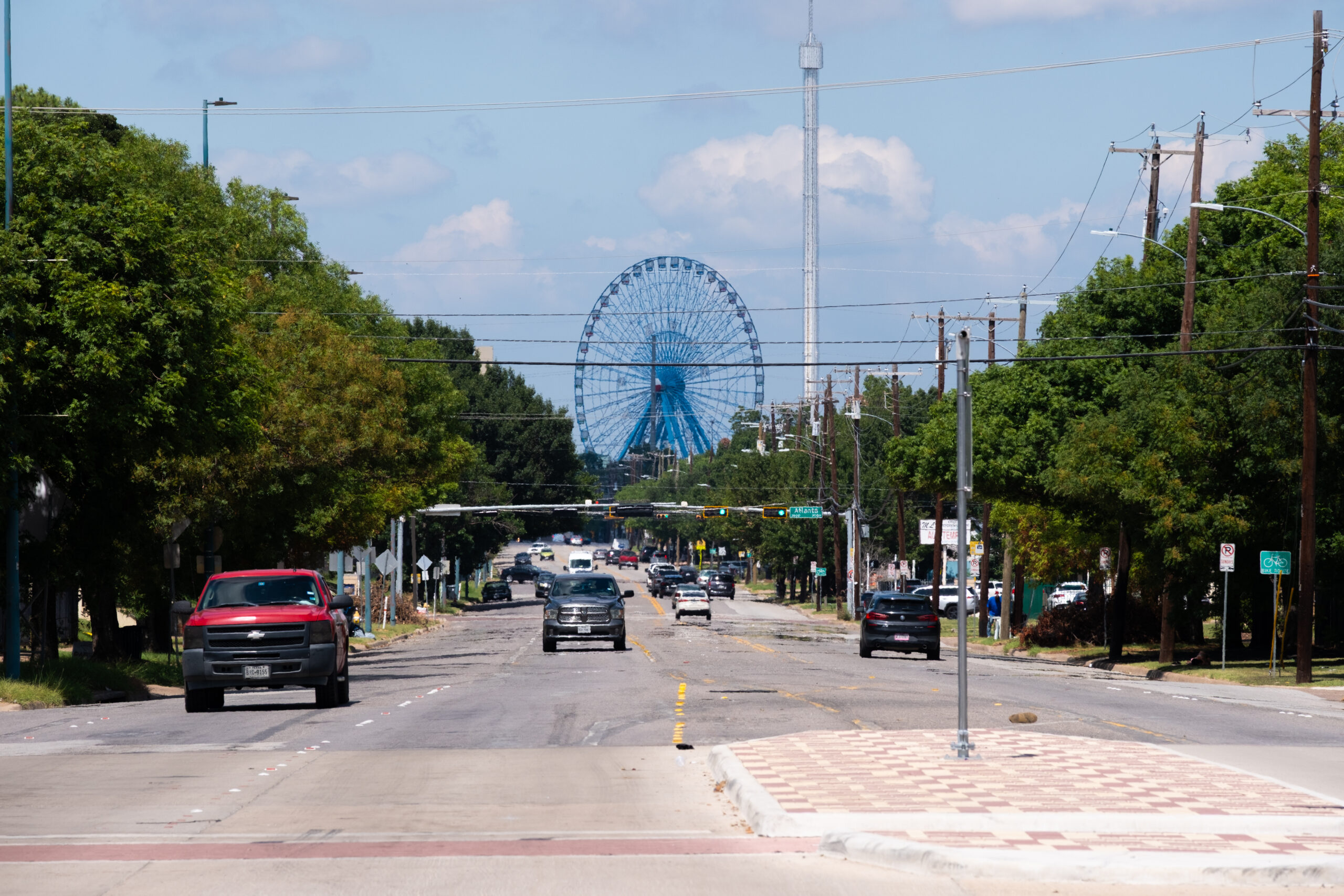
Looking east down Martin Luther King Jr. Boulevard from S. M. Wright Freeway on Monday, Aug. 4, 2025, in South Dallas. Photo by Camilo Diaz Jr.
They have the capacity to transform the neighborhood. Two of them are Black, all are local families, and “every one of them is worth $10 or $20 million dollars,” Lawson says. And they can decide whether to sell their land and to whom. Lawson thinks too many people fail to realize that.
With Lawson at the helm, Pointe South has done its best to carve out a place for, to be the voice of, the South Dallas/Fair Park people, who are too easily silenced by stakeholders in Fair Park and Deep Ellum, major entertainment districts that flank their neighborhood.
Lawson says he wants to see new construction, just not of grossly out-of-character houses or buildings, and many of his neighbors have expressed the same.
The right development, Lawson says, will be a catalyst, attracting more growth and prompting the resurgence of local businesses and the hyperlocal economy. It would light up dark corners that allow crime to thrive and draw municipal attention to a neighborhood whose needs have been ignored for too long.
In addition to facilitating communication among the landowners, Lawson and Pointe South have garnered the attention and cooperation of new city manager Kimberly Tolbert, a type of support he says they have not received in the past. (Her office has acknowledged an inquiry from Dallas Free Press, but is awaiting more information before commenting.)
Those things are worth celebrating, Lawson says, but there is much more to do.

Hank Lawson and Zach Thompson drive past new homes in South Dallas on Aug. 14, 2025. Photo by Camilo Diaz Jr.
Does South Dallas have the right developer?
At the close of March’s Pointe South revitalization meeting, a teary-eyed Lawson said he was stepping down as chair.
His body is telling him to slow down, he says. (Side note, he told the Dallas Observer the same thing in 2006 when at age 63 he retired as executive director of South Fair Community Development Corporation.)
He used a good portion of the meeting to stress the vital importance of local commercial property owners — who hold a lot of power when it comes to what happens around the MLK station — and of bringing in a developer who understands the community’s wants and needs.
“We have 6,000 plans on the shelf at City Hall. But this time we have two very important things that are different,” Lawson says. “We have a legitimate developer and we have property owners ready to work with them, the City, and the tools our city has to incentivize development.”

In March 2025, Hank Lawson announced at a Pointe South Revitalization Committee meeting, now the Pointe South Business Group, that he would step down as chair. Photo by Camilo Diaz Jr.
The developer of which Lawson speaks is Woda Cooper, which recently withdrew its proposal to build a 120-unit multifamily community on land they planned to purchase from Hall, Perez and Bryant near MLK Station. Woda Cooper senior vice president Jason Lain says they have not abandoned the project but are changing course related to how they will finance it.
Because of the enormous need for housing, federal and local governments offer tools to incentivize its construction. Woda Cooper needs to utilize such a tool to make the dollars work and appears to be weighing the political prospects of what the City and South Dallas neighbors will support.
Deptula says the landowners got “locked up under contract with Woda, so we were not talking to other people. But with that terminated, we are now back at square one.”
Deptula reiterates Lawson’s point that the landowners can sell to whomever they want, whenever they want, yet are under no obligation to do so. They will hold out, earning revenue from seasonal State Fair parking, before being pressured into an unfair deal, he says.
“We aren’t a charity,” he says. “We are owners that want something to happen because it’s great for the community, but also there’s financial incentive to do so. There’s no shying away from it. We want to make money, and we want to be fair.”
South Dallas and the City around the Pointe South table
Bryant, Perez and Hall were semi-regulars at Pointe South meetings until April. That’s when Lawson convened a pre-meeting with City department heads and the corridor’s primary landowners, who represented a combined valuation of more than $200 million in potential development.
The gathering represented Lawson’s long-held ambition to put landowners and City staff in a room together to talk face to face about the City’s tools and the landholders’ requirements — all with the ultimate goal of making South Dallas the kind of neighborhood he and his fellow residents deserve to live in.
Lawson hoped it would be “a historic moment.” Instead, it marked the end of Bryant, Perez and Hall’s involvement with the Pointe South Committee.
Deptula, who never once graced Fourth Avenue Church of Christ with his presence for a Pointe South meeting, reasons that the commercial landowners need room to work, some freedom from the neighborhood residents’ opinions, which can overlap and hinder progress like too many cooks in a kitchen.
“I think the community needs to allow the owners to be able to handle what they need to handle,” he says.
Not long after Lain attended that month’s Pointe South meeting,Woda Cooper withdrew its proposal. He says they are looking at a different tax incentive to make the project happen.
“What I will say is that we’re not going to quit. We will figure this out,” says Lain, who was raised in Dallas and declares a strong passion for the city. “We’re gonna come to a spot and make it work. I believe this is going to act as a catalyst to get to that big audacious goal, which is making this area as beautiful as it can be.”

Zach Thompson, interim chair of the Pointe South Business Group, speaks during a meeting on Aug. 25, 2025, at the Fourth Avenue Church of Christ. Photo by Camilo Diaz Jr.
As Pointe South’s leadership and focus changes, its objective remains
Lawson likes to share his story about Pointe South’s origin. It was four years ago at Graham’s Barber College on Al Lipscomb Way, when he first connected with Bryant and Zach Thompson, who owns a vacant lot near Fair Park that he uses for event parking.
The topic of discussion was how to reduce crime in the area so that small and Black-owned businesses could thrive. Today, just like then, that is the ultimate objective, Lawson says.
The antithesis, he regularly points out, is what happened to Dallas’ Black communities in Deep Ellum, State Thomas and elsewhere — displacement. With investment finally flowing into South Dallas and the desirability of local land, “we have to be vigilant,” Lawson says.
“I don’t have to tell you that this market is hot, hot, hot. Everybody wants to buy our land and do something, but we know what has happened in the past,” Lawson said to the Pointe South committee in June. “As I step away, I’m hoping and praying that we can continue that fight.”
True to his promise last spring, Lawson passed his Pointe South chairperson baton. Thompson agreed to act as interim through December. Lawson remains involved along with Derrick Mitchem, who owns the Motor Sports Museum at the historic Bama Pie Company building, and Traswell C. Livingston III, a real estate broker and City of Dallas Landmark Commissioner who lives near Lawson in the historic South Boulevard/Park Row neighborhood. Ken Smith, founder of the Revitalize South Dallas Coalition, is part of the core group, too.
The five men now call Pointe South a “business group” rather than a “revitalization committee” and have shifted their primary focus for now from property owners and a potential development project to the 2026 FIFA Fan Festival — the World Cup-related event, which could have a profound economic and social effect on the area surrounding it, will be hosted next summer at Fair Park.
“The concern is, we still need more information on how African-Americans and Hispanics will have business opportunities in the FIFA activities,” Thompson told the Dallas Park and Recreation board at their August meeting.
According to Lawson and new Pointe South members, FIFA is just the latest instance of South Dallas residents and property owners feeling left out of conversations and decisions that directly impact them.
Still, Thompson credits Dallas Sports Commission leader Monica Paul and her team for showing up at the last two Pointe South meetings to present more FIFA-related action steps.
It’s the “showing up” that Lawson deems most valuable. For him, bringing everyone together is not a means to an end but the goal.
That’s why he’s worked so diligently to draw MLK corridor landowners, lenders and leaders into a single room, every month. No small feat.
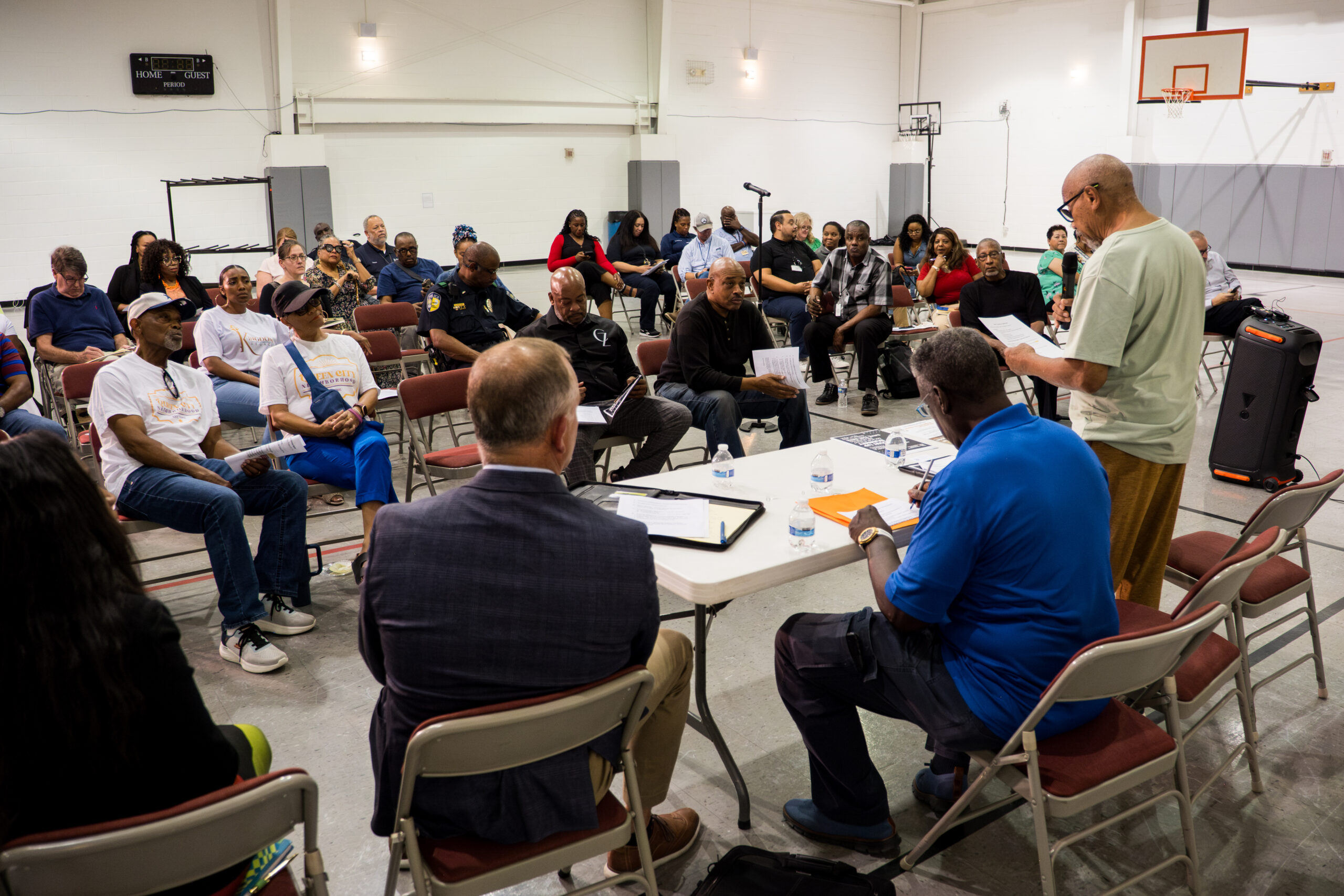
Attendees listen to remarks during a Pointe South Business Group meeting on Aug. 25, 2025, at the Fourth Avenue Church of Christ. Photo by Camilo Diaz Jr.
An even greater super power has been his ability to persuade City staffers to attend meetings where they may well be chastised—for he refuses to coddle or bend when it comes to the safety and success of his neighborhood—and to no less return the next month.
“They may sit in the back, alright, but they’re here. The new ones sit up front because they don’t know any better,” Lawson quipped during June’s meeting.
City officials who came for one reason often accomplished something more far-reaching.
“They come here to help us, but they leave here with a better understanding of how to make their programs more effective and how to work with us.”
This improved relationship between City and neighborhood, he says, has made the disintegration of a much-desired development in the MLK corridor a bit easier to swallow.
Share This Story, Choose Your Platform!