South Dallas’ Queen City pushes for historic district designation

Newsletter
This content originally was a newsletter Dallas Free Press emailed to insiders. To become one, sign up here for free.

South Dallas is full of important history. But much of it isn’t officially recognized.
Take the recent S.M. Wright Freeway debacle. The name of the late pastor, who shepherded People’s Missionary Baptist Church from 1957 until his death in 1994, was left off new street signage as TxDOT leveled the raised freeway to create a six-lane, street level boulevard with traffic signals.
The culprit was a 30-year-old City of Dallas mistake — the City never completed the application to officially change the name. South Dallas pastors showed up in droves demanding answers from City Council, and were promised the error would be fixed. (Corrected street signs went up a week later.)
Or consider the Kathlyn Joy Gilliam Museum in Colonial Hill, which was nearly destroyed by two fires in late 2020 and early 2021, then fully restored by Gilliam’s daughter, Constance Harris. The home of the first Black woman elected to the Dallas school board couldn’t be found on Google Maps, we noticed while publishing the second story, so we submitted it to make it easier for people to visit. Now, more than 65,000 people have viewed it, Google tells us.

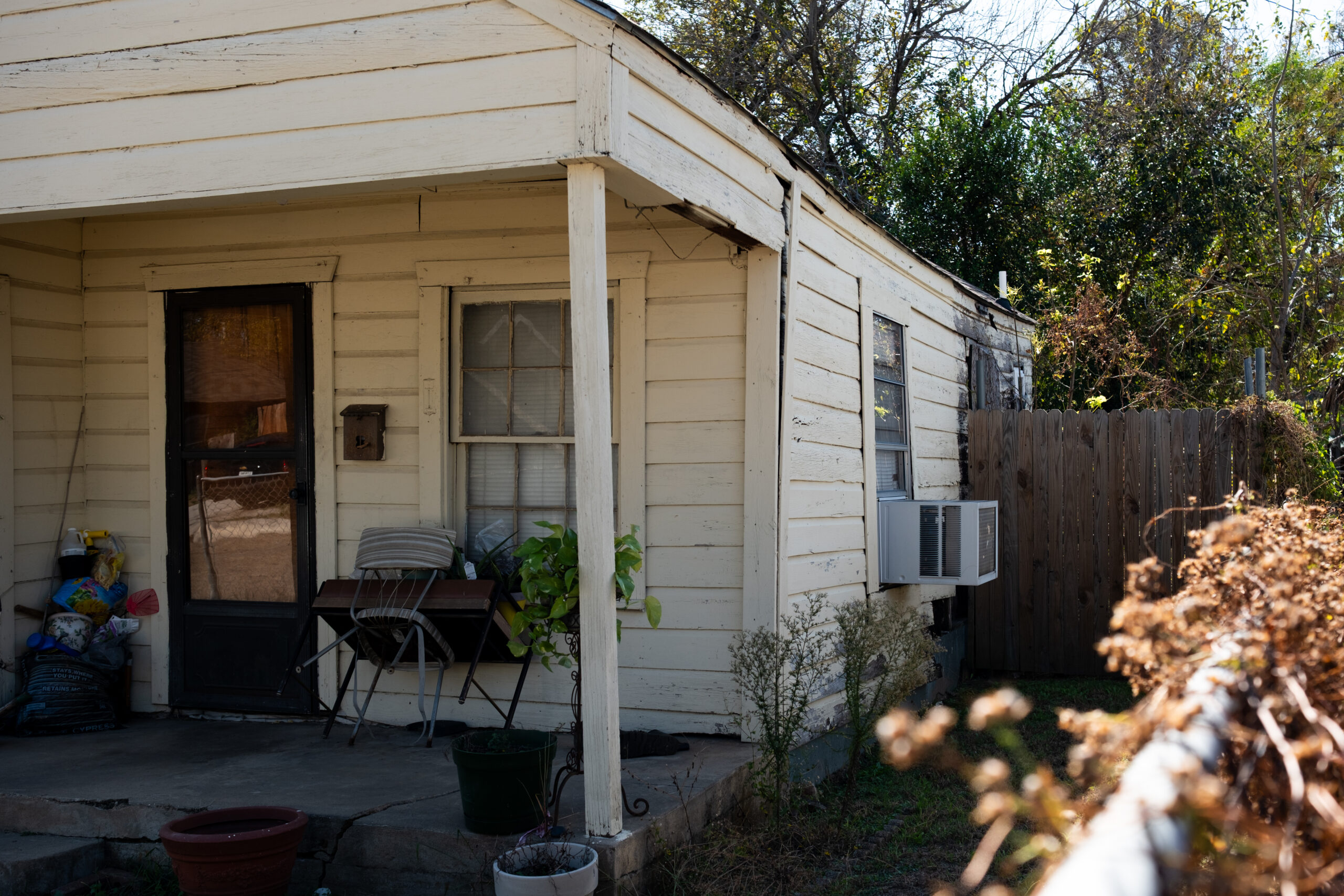
The latest South Dallas effort to preserve history is led by Eva Jones — a push for the City to designate her longtime Queen City neighborhood as a historical district. Jones received unanimous approval from the City of Dallas Landmark Commission to begin the process, which will include a series of community meetings before Queen City neighbors can return to the Landmark Commission, then the City Plan Commission and finally City Council.
If you haven’t read the history of Queen City that earned its spot in the National Register of Historic Places, there are several gems inside:
- Queen City “once served as the physical nucleus of South Dallas’ African-American suburban development, and is located only a few blocks south of the ‘color line,’ which until World War II delineated African-American residential development from white neighborhoods to the north and west.”
- “Almost all the land that includes the Queen City Historic District and surrounding areas was settled by white farmers after the Civil War. … African-American settlement in the immediate vicinity of Queen City can be traced as early as the 1874 Romine Avenue Christian Church … By 1905, African-American residents on Greer Avenue east of the railroad tracks outnumbered the white residents.”
- The area now known as “Queen City” originally was developed as the Queen City, Bermuda Lawn and Rosedale additions, and later Queen City Heights and the Oak Grove Addition, [then] “in 1912 a street car line was extended south from Forest Avenue along Myrtle Avenue … to serve the growing African-American suburban additions. The stop at Romine Avenue, nearest the Queen City Heights Addition, was called the “Queen City” stop. The moniker became identified with the larger community.”
- “The only major African-American institution in South Dallas outside the immediate Queen City vicinity before about 1928 was [Phyllis] Wheatley School, and even it was known as Queen City School until the new brick building was constructed in 1929.”
And so much more. Read it for yourself.
The City’s recognition of Queen City as a historic district is not guaranteed. A designation would mean anyone who wants to demolish, construct or alter a Queen City home would need to first obtain a “Certificate of Appropriateness” that meets the established historic preservation criteria.
On the one hand, as Jones pointed out to Landmark Commissioners, this would help stabilize property values and “stop the gentrification and displacement” with $300,000-plus homes “going up overnight.” On the other hand, as neighbors pointed out during this week’s South Dallas Fair Park Faith Coalition meeting, the preservation criteria could make it more difficult for current homeowners to repair or sell their homes.
Though City Council will take the final vote, it’s ultimately up to neighbors to decide whether and how they want to preserve their history as South Dallas moves into the future.
Share This Story, Choose Your Platform!

Keri Mitchell has spent 20+ years as a community journalist, including 15 years dedicated to community and civic journalism at Dallas’ Advocate magazines. She launched Dallas Free Press in early 2020 with the belief that all neighborhoods deserve reporting and storytelling that values their community and holds leaders accountable.
Mitchell says she is energized by “knowing our work is making an impact — listening to people, telling their stories with strong narratives paired with compelling data that leads to change. I also love spending time in our neighborhoods and with our neighbors, learning from them and working to determine how journalism can be part of the solution to their challenges.”
Mitchell is proud to be the winner of multiple awards during her journalism career including: Finalist in Magazine Feature Reporting (2018) and Finalist in Magazine Investigative Reporting (2017) from Hugh Aynesworth Excellence in Journalism, Best Feature Story (2011) from Texas Community Newspaper Association and Best Magazine Feature (2011) from Dallas Bar Association Philbin Awards.
Areas of Expertise:
local government, education, civic issues, investigative and enterprise reporting
Location Expertise:
Dallas, Texas
Official Title:
Founder + executive director
Email Address:
keri@dallasfreepress.com