Stanford doctoral candidate pairs youth with South Dallas history, elders

The idea to bridge together youth and elders through Black history began at Bethany Bass’ grandparents’ kitchen table.
She was curious to learn more about her family’s history in South Dallas. She wanted to preserve conversations with her paternal grandfather, Charlie Ray Thomas, who grew up on Lawrence Street and graduated from Lincoln High School in 1968, and her maternal grandmother, Gustavia Thomas, who grew up in Bonton and graduated from Lincoln in 1972.
“I would go and witness their storytelling on Sundays, and I started an oral history project with my grandparents,” she says.
The Garland native is currently a doctoral candidate at Stanford University studying race, inequality, language and education, the history of education.
After doing her own research of South Dallas, Bass says she wanted to bring young people from the community along in the research process.
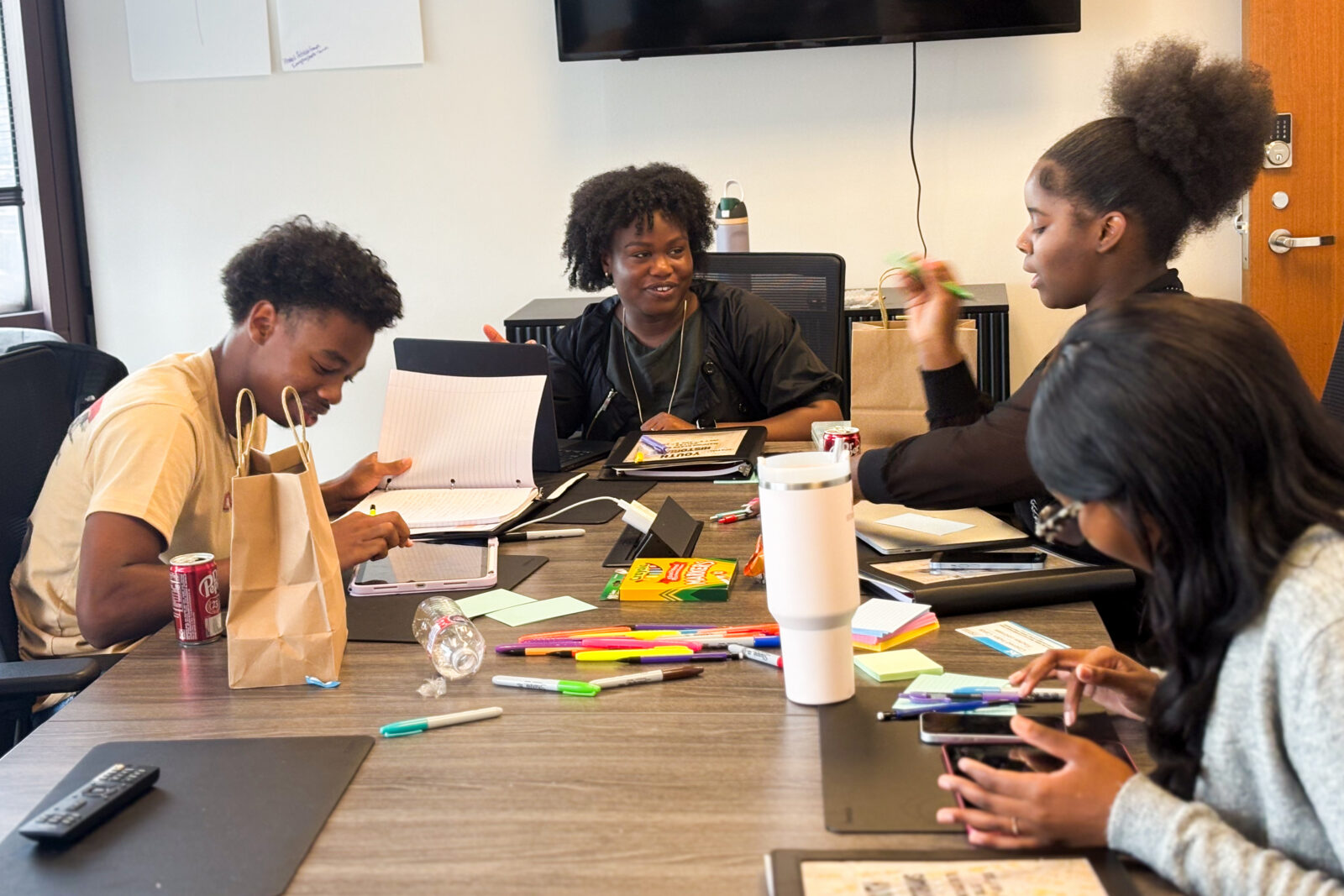
Over the summer she led a five-week fellowship program in South Dallas called “Youth Spatial Historians DTX.” Spatial history is the use of maps and geography to tell the story of communities or individuals. It uses research data to show how history was written in correlation with where it took place.
The program was funded by a grant from the Stanford Accelerator for Learning, which focuses on supporting research that centers in teaching, use of technology and service of equity.
The program engaged current high school students and recent graduates with South Dallas Black history by teaching them the tools of archival research, oral history, participatory mapping and intergenerational storytelling.
“I wanted to bring young people along in the process of researching this area, and particularly young people from the community,” Bass says.
Students visited various institutes learning to do archival research: Dallas Public Library, the African American Museum of Dallas, Warren United Methodist Church, Innercity Community Development Corporation, Kathyln Joy Gilliam Museum and the Juanita Craft Civil Rights House and Museum. They also conducted oral history interviews with legacy residents- all while giving the students tools to conduct research on topics that they wanted to uncover on their own about South Dallas.
The program concluded with an intergenerational storytelling event at the South Dallas Cultural Center where students had the stage to present their research. Thirty-three people attended, the eldest attendee was 94-years-old and the youngest was 8 months. The students also organized intergenerational storytelling stations where people would sit down and share stories. One of the stations included a participatory mapping exercise where residents would put dots on a map that held a special meaning in South Dallas.
Learn more about each Youth Spatial Historian’s research.
Share This Story, Choose Your Platform!

Prior to joining the Dallas Free Press as a visual journalist, Camilo Diaz Jr. was a video intern at KERA, the NPR and PBS member station for North Texas, where he developed a deep appreciation for video production. He also worked as a multimedia fellow at the Fort Worth Report, covering local news in his hometown. As a teenager, he began documenting his community and identity through photography, leading him to the world of photojournalism. He went on to earn a bachelor’s degree in journalism with a concentration in photojournalism from the University of North Texas.
Beat: Visual and multimedia approach to capturing community and civic life
The images of our communities that appear in local news media are mostly of crime and blight, which doesn’t at all reflect their beauty and assets. This visual journalist sees neighbors and captures community and civic life in all of its facets. The journalist is a multimedia reporter with a photographic eye, who has the skills to meld images, video and audio for storytelling, and the desire to reach under-covered audiences.